Could you be one of the 2.5 million Brits pulled into the 60% tax trap by 2031?
A pay rise or bonus might result in more money in your pocket come payday, but there exists an unusual quirk of the UK tax system that could see your effective rate of Income Tax rise to 60% on part of your income.
This is often referred to as the “60% tax trap”, and it’s an issue that could become even more relevant over the next few years as tax thresholds remain frozen and salaries continue to rise.might find yourself affected even if your income currently sits below £100,000.
With this in mind, continue reading to learn how the 60% tax trap works and some steps you could take to mitigate its effects.
The 60% tax trap is caused by the gradual loss of your Personal Allowance
In the 2026/27 tax year, the standard Personal Allowance stands at £12,570. This is the amount you can typically earn before you start paying Income Tax.
However, once your adjusted net income reaches a certain level, this allowance starts to fall by
£1 for every £2 your adjusted net income exceeds £100,000. The table below shows how your effective Personal Allowance would change depending on your earnings.
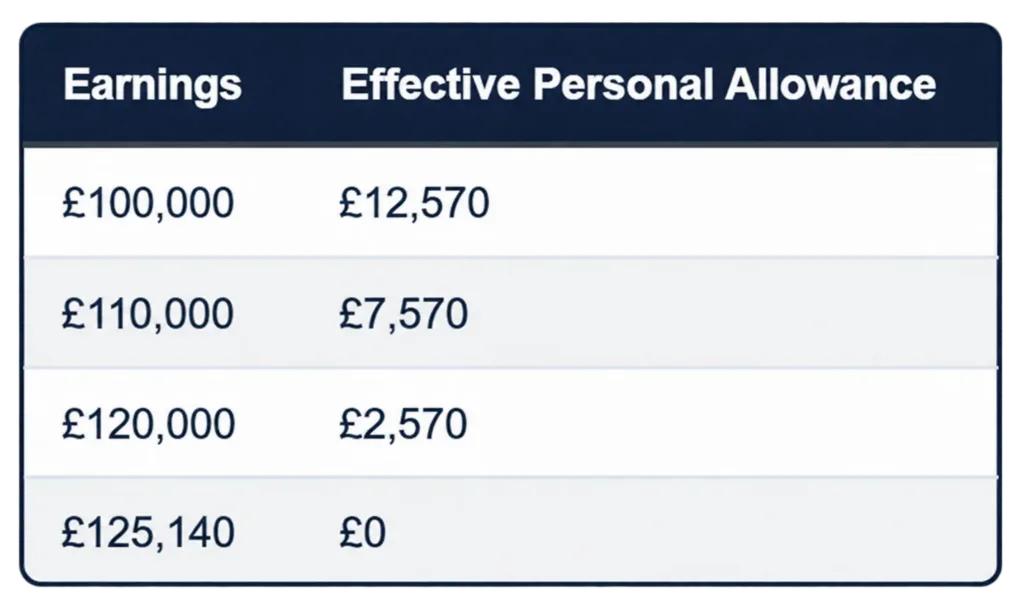
For taxpayers in England, Wales, and Northern Ireland, income in the £100,000 – £125,140 range would normally be subject to the 40% higher-rate Income Tax.
However, since you’re losing part of your tax-free Personal Allowance, the effective marginal rate of Income Tax on these earnings can reach 60%.
A £10,000 pay rise could result in an additional £6,000 Income Tax bill
To understand just how much the 60% tax trap could affect you, imagine you have an adjusted net income of exactly £100,000. In this case, you receive the full £12,570 Personal Allowance.
You then receive a £10,000 work bonus, taking your adjusted net income to £110,000. Normally, you might expect that additional £10,000 to be taxed at the 40% higher rate, resulting in an additional £4,000 in Income Tax.
However, since your income now exceeds £100,000 by £10,000, you also lose £5,000 of your Personal Allowance. This £5,000 becomes taxable, creating an additional £2,000 Income Tax liability.
Of the extra £10,000:
- £4,000 tax is paid due to your 40% marginal rate
- £2,000 tax is due on the £5,000 lost from your Personal Allowance.
This creates an effective 60% rate of Income Tax.
Of course, this example only considers Income Tax. National Insurance contributions could also affect how much of your income you keep.
It’s important to remember that levels, bases of, and reliefs from taxation are subject to change and their value depends on your individual circumstances. For that reason, this article does not constitute tax advice and should not be relied upon as such. You should always seek professional advice, so get in touch if you have questions about anything you have read.
Frozen tax thresholds mean more people could enter the trap
Frozen thresholds are a type of stealth tax that gradually pull taxpayers into higher brackets without the government needing to increase headline rates. This is described as “fiscal drag”.
For instance, if you currently earn £90,000 and your salary increases by 4%, you could exceed £100,000 after a few years. Your tax bill could rise significantly, simply through expected wage growth and without a change to headline rates.
It’s also vital to note that returns from your savings, property, or dividends can all be classed as income and contribute towards the £100,000 threshold.
As such, it may be prudent to track your overall taxable income if you are approaching the tax trap threshold.
Pension contributions and charitable giving could help reduce your adjusted net income
Perhaps one of the simplest ways to mitigate the 60% tax trap is by increasing your pension contributions.
Doing so essentially reduces your adjusted net income used to calculate your Personal Allowance.
Using the previous example, imagine your adjusted net income was £110,000, and you made a £10,000-plus pension contribution.
Your adjusted net income would fall below £100,000, giving you your full Personal Allowance.
What’s more, the money would be invested in your pension, likely benefiting from tax relief and helping support your desired lifestyle when you stop working.
The pension Annual Allowance stands at £60,000 as of 2026/27, but the amount available to you could be lower if you’re a high earner or have already accessed your pension flexibly. So, it’s essential to understand which allowances apply before you make any significant contributions to your pot.
It’s also worth noting that charitable donations could offer another practical way to reduce your adjusted net income over time. When you make an eligible Gift Aid donation, you can deduct the value of the gift when calculating your income.
For example, an £800 donation could be treated as £1,000 when basic-rate tax relief is included.
As such, charitable giving could potentially help you retain more of your Personal Allowance, all while supporting a cause that matters to you.
Get in touch
If you’re approaching or already affected by the 60% tax trap, we could help you consider how you can improve your tax efficiency while keeping your long-term goals in mind.
Please contact us if you have any questions. De Mellow & Co’s expert financial planners are on hand to help.
SJP Approved 03/11/2026